Why do Wrinkles Occur During Film Coating?
In the plastic film coating industry, meticulously formulated coatings and well-tuned equipment, only to produce a finished film riddled with orange peel patterns, is undoubtedly a major frustration. This issue is more than just a cosmetic issue—it directly impairs the product’s optical performance, interferes with subsequent lamination or printing processes, and can even lead to customer returns. Orange peel patterns are a production nightmare and a cost killer. This article will delve into this persistent problem, exploring solutions from both the micro and macro levels.
Analysis of the Causes of Orange Peel Patterns
Microscopic Level:
1. Surface Tension Differences: Uneven solvent evaporation rates in wet coatings (e.g., faster evaporation at the edges and thinner areas than at the center and thicker areas) lead to increased coating concentration and localized surface tension in these areas. Liquids have the characteristic of flowing from areas of low surface tension (e.g., thick coatings with high solvent content) to areas of high surface tension (e.g., faster evaporation and higher concentration) to balance the tension difference. This backflow is the microscopic origin of orange peel patterns. 2. Exacerbating effects of uneven evaporation rates: Excessively rapid solvent evaporation or drastic fluctuations in ambient temperature and humidity can cause the coating surface to solidify rapidly, forming a “film.” The solvent within must break through this film to escape, potentially leading to uneven surface shrinkage and wrinkling. Complex solvent compositions (such as a mixture of fast-drying and slow-drying solvents) are more likely to produce significant concentration differences and tension gradients during evaporation, exacerbating flow disturbances.
3. Insufficient leveling dynamics: Excessively high coating viscosity or short leveling time (e.g., excessively fast coating speeds) prevents the molecules from fully flowing before curing to smooth out unevenness caused by tension differences. High viscosity acts as a barrier to the coating’s “flowability.”

Macro-Level:
1. Impact of Coating Operation:
Coating Weight Fluctuation: Wear, blockage, or improper settings of metering equipment (such as anilox rollers and doctor blades) can lead to uneven coating. Thin areas are prone to shrinkage during curing, while thick areas are prone to sagging, both of which can cause orange peel.
Substrate Issues: Uneven surface tension, micro-contamination, or poor flatness of the film substrate can disrupt the continuity of coating spread, resulting in poor wetting or accumulation.
2. Drying Process Defects:
Uneven Temperature Field: Uneven temperature distribution within the oven or improper air vent design can cause significant differences in curing rates at different locations on the coating.
Inappropriate Air Speed: Excessively high air speeds can strongly disturb the wet film surface, causing ripples; excessively low air speeds can cause solvent vapor to entrap, affecting uniform volatilization.
3. Coating Formulation Issues:
Poor Rheological Properties: Lack of appropriate rheological additives or an inappropriate resin-solvent system combination can lead to rapid viscosity recovery after high shear, resulting in a short leveling window. Solvent matching error: The solvent volatilization gradient is unreasonable or the compatibility with the resin is poor, which can easily cause tension gradient problems or local precipitation.
Key Measures to Avoid Orange Peel
1. Optimizing Coating Formulations:
Adding a High-Performance Leveling Agent: Significantly reduces and evens out the coating’s surface tension, counteracting tension gradients. The dosage must be rigorously tested.
Scientifically Designing the Solvent System: Adopting a “Fast-Medium-Slow” solvent blend strategy ensures a smooth evaporation and a reasonable gradient. Incorporating an appropriate amount of a high-boiling-point solvent can be used as needed.
Adjusting Rheology: Using additives to adjust the coating’s viscosity ensures proper recovery after high shear and sufficient leveling time.
2. Precisely Controlling the Coating Process:
Ensuring Substrate Quality: Strictly monitor the film’s surface treatment to maintain cleanliness and smoothness.
Maintaining the Coating Unit: Regularly inspect and clean the coating roller and doctor blade to prevent wear or blockage. Accurately set and monitor the coating gap and pressure.
Adjusting Coating Parameters: While meeting production requirements, appropriately increase the wet film thickness or reduce the line speed to extend the leveling time.
3. Optimize Drying Conditions:
Ensure Temperature Uniformity: Regularly calibrate the oven temperature sensor and optimize the air duct design to ensure a uniform temperature field. Utilize zoned, precise temperature control.
Control Air Speed and Volume: Avoid direct hot air onto the wet film. Use a “low air speed, high air volume” mode or install air flow guides to ensure even and gentle hot air flow across the film surface.
Implement a Gradient Temperature Ramp: Set the oven temperature gradient from low to high to prevent rapid drying at the wet film entrance.
4. Strictly Control the Environment: Maintain a constant temperature and humidity in the coating room to minimize the impact of environmental fluctuations on solvent evaporation and coating rheology.
Conclusion and Cutting-Edge Technologies
Orange peel texture is a common challenge in plastic film coating. Its causes involve a wide range of microscopic physical effects and macroscopic process control. Only by deeply understanding its formation mechanisms and systematically fine-tuning the formulation, process, equipment, and environment can this problem be effectively overcome and a smooth, even coating be achieved.
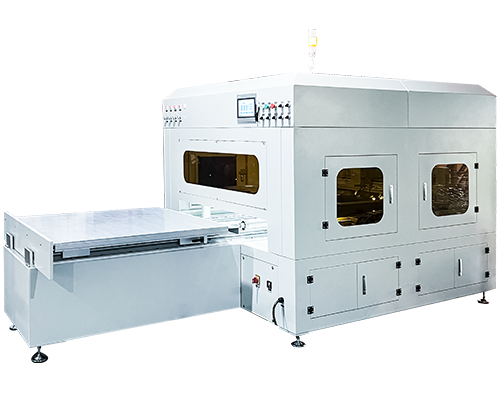
Notably, ultrasonic coating technology is demonstrating unique advantages in addressing orange peel texture. This technology utilizes high-frequency ultrasonic vibrations applied to the coating or coating system. Its core mechanism is:
Promoting micro-mixing and homogenization: The cavitation effect and intense acoustic streaming generated by ultrasound effectively break up coating agglomerates, ensuring a more even distribution of ingredients (especially key additives such as leveling agents), significantly reducing local surface tension variations.
Reducing effective viscosity and enhancing leveling: Sonic energy temporarily reduces the apparent viscosity of the coating, significantly improving its leveling ability and making it easier to eliminate minor ripples and unevenness before curing.
Improving substrate wetting: Ultrasonic energy helps enhance the coating’s wettability to the substrate, reducing defects caused by poor wetting.
Using ultrasonic coating technology can fundamentally suppress surface tension gradients and insufficient leveling dynamics—the key causes of orange peel texture. This provides strong technical support for achieving higher-quality coating surfaces and represents a key direction for process optimization.
About Cheersonic
Cheersonic is the leading developer and manufacturer of ultrasonic coating systems for applying precise, thin film coatings to protect, strengthen or smooth surfaces on parts and components for the microelectronics/electronics, alternative energy, medical and industrial markets, including specialized glass applications in construction and automotive.
Our coating solutions are environmentally-friendly, efficient and highly reliable, and enable dramatic reductions in overspray, savings in raw material, water and energy usage and provide improved process repeatability, transfer efficiency, high uniformity and reduced emissions.
Chinese Website: Cheersonic Provides Professional Coating Solutions