Ultrasonic spraying machine for spraying touch screens
Ultrasonic spraying machine for spraying touch screens-Cheersonic
In diverse fields such as consumer electronics, industrial control, smart homes, and public services, touchscreens, as the core carrier of human-computer interaction, have become an essential component of various smart devices due to their core advantages of convenient operation and intuitive display. Touchscreens mainly consist of touch detection components, touchscreen controllers, and displays. Core types include capacitive, resistive, and optical touchscreens. Capacitive touchscreens, with their high sensitivity and high light transmittance, are widely used in mobile phones, tablets, and smart terminals, while resistive touchscreens, due to their advantages of moisture and dust resistance and the ability to be operated while wearing gloves, are suitable for special scenarios such as industrial control and medical equipment. The spraying process, as a key step in touchscreen manufacturing, bears the heavy responsibility of coating core structures such as the ITO conductive layer, anti-reflective coating, and oleophobic layer, directly determining the touchscreen’s touch sensitivity, light transmittance, and lifespan. Cheersonic ultrasonic spraying machines, with their core advantages of high precision, low damage, and high adaptability, perfectly meet the spraying needs of touchscreens, providing core equipment support for their large-scale mass production and high performance.
The diverse types and high-performance requirements of touchscreens have placed extremely stringent standards on the spraying process, with the touch experience deeply intertwined with the spraying quality. The core spraying process for touchscreens focuses on the application of the ITO conductive layer, anti-reflective coating, and oleophobic layer. The functional requirements of different coatings determine the differentiated standards of the spraying process. The core spraying requirements are concentrated in three main aspects: First, high uniformity coating, requiring precise control of coating thickness and distribution to adapt to the needs of different sizes and types of touchscreens, with a deviation ≤ ±0.05μm and uniformity exceeding 98%, avoiding defects such as pinholes, coating buildup, and streaks, ensuring uniform conductivity of the ITO conductive layer and excellent light transmittance of the anti-reflective coating, guaranteeing accurate touch response; Second, Low-damage adaptation: Touch screen substrates are mostly ultra-thin glass and PET flexible film, with delicate and fragile surfaces. The spraying process must be carried out under low pressure and without high temperature to avoid scratches and damage to the substrate. At the same time, it must ensure strong adhesion between the coating and the substrate to prevent coating peeling and touch failure during long-term use. Thirdly, high-cleanliness adaptation: Touch screens have extremely high cleanliness requirements. Impurities must be eliminated to avoid affecting light transmittance and touch sensitivity. At the same time, it must be adapted to the characteristics of consumables such as ITO conductive materials and optical adhesives to ensure that the coating is free of bubbles and particle agglomeration after spraying, meeting the stringent standards of touch display.
In the current field of touchscreen coating, traditional coating processes (air spraying, spin coating, and blade coating) have many shortcomings, making it difficult to adapt to the diverse types and high-performance preparation requirements, thus becoming a bottleneck restricting the improvement of quality and efficiency in the touch industry. Air spraying relies on high-pressure airflow, which easily leads to uneven droplets and inconsistent coating thickness. High-pressure impact can also scratch ultra-thin glass or PET substrates. At the same time, high-pressure airflow can easily introduce impurities, affecting the light transmittance and touch sensitivity of the touchscreen. Spin coating has a material utilization rate of less than 40%, wasting a large amount of expensive ITO conductive material. Moreover, it is only suitable for small-sized touchscreens and cannot meet the mass production needs of large-sized industrial touchscreens and automotive touchscreens. Blade coating is prone to coating scratches and thickness deviations. It is only suitable for simple coating and cannot be adapted to the preparation of precision coatings such as anti-reflective and oleophobic coatings, making it difficult to meet the performance requirements of high-end touchscreens.
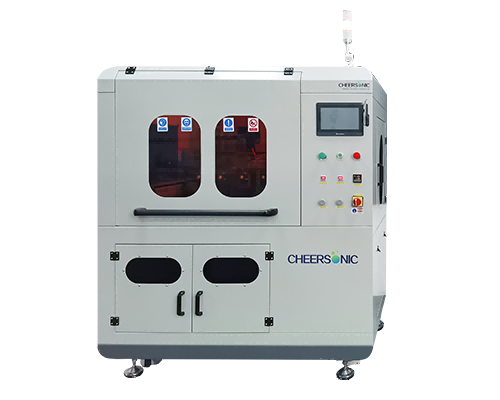
Cheersonic ultrasonic spray coating machine addresses the characteristics and pain points of touchscreen coating by leveraging its core high-frequency atomization technology and combining it with key aspects of touchscreen manufacturing processes to create customized solutions, completely breaking through traditional process bottlenecks. The equipment converts industrial frequency electricity into a 40-150kHz high-frequency electrical signal via an ultrasonic generator, which is then converted into high-frequency mechanical vibration by a piezoelectric ceramic transducer. Utilizing the ultrasonic cavitation effect, the coating material is atomized into fine droplets of 0.01-3 microns, effectively de-agglomerating particle clusters in the material, ensuring a uniform and delicate coating, perfectly suited for coating requirements of ITO conductive layers, anti-reflective coatings, and oleophobic layers. The atomization process is low-pressure and high-temperature-free throughout. The droplets are gently deposited on the substrate surface guided only by a slight carrier gas, without scratching ultra-thin glass or PET flexible substrates, and without damaging the coating’s functional properties. It maximizes the preservation of the touchscreen’s high light transmittance and touch sensitivity, while precisely controlling the coating thickness and flexibly adjusting spraying parameters to adapt to the manufacturing needs of different types and sizes of touchscreens, including capacitive and resistive types.
Addressing the coating needs of touchscreens, Cheersonic ultrasonic spraying machines offer four core advantages, helping companies achieve large-scale, high-quality mass production of touchscreens. First, high-precision coating: coating uniformity exceeds 98%, with a deviation of ≤±1%, ensuring uniform distribution of the ITO conductive layer and excellent light transmittance of the anti-reflective coating, guaranteeing accurate touch response and clear display. Second, low-damage protection: low-pressure, gentle atomization technology avoids substrate scratches and coating damage, adapting to ultra-thin glass and flexible PET substrates, balancing coating adhesion and the structural integrity of the touchscreen. Third, high material utilization: reaching over 95%, significantly reducing waste of consumables such as ITO conductive materials and optical adhesives, lowering touchscreen manufacturing costs, and meeting the high-efficiency utilization requirements of high-end touchscreen consumables. Fourth, excellent mass production adaptability: supporting automated continuous spraying and cleanroom adaptation, seamlessly integrating into large-scale touchscreen production lines, adapting to different product models in various scenarios such as mobile phones, industrial control screens, and automotive touchscreens, solving the problems of low efficiency, high waste, and poor consistency of traditional processes.
Currently, Cheersonic ultrasonic spraying machines are widely used in touchscreen spraying scenarios, covering core areas such as ITO conductive layer coating for capacitive touchscreens, coating preparation for resistive touchscreens, and anti-reflective and oleophobic layer spraying. This helps companies solve problems such as touch malfunction and poor light transmittance caused by traditional spraying processes, achieving breakthroughs in high-quality touchscreen manufacturing and large-scale mass production. As a leading company in the field of ultrasonic electronic equipment, Cheersonic Ultrasonic has been deeply involved in touch display spraying for many years, keeping abreast of touchscreen technology development trends. It can provide customized spraying solutions, covering the entire process from equipment selection and process parameter optimization to coating adaptation for different types of touchscreens, helping customers fully leverage the core advantages of touchscreens. In the future, Cheersonic Ultrasonic will continue to optimize equipment performance to meet the needs of touchscreen upgrades towards thinner, lighter, more sensitive, and larger sizes, injecting strong momentum into the high-quality development of industries such as consumer electronics, industrial control, and smart homes.
About Cheersonic
Cheersonic is the leading developer and manufacturer of ultrasonic coating systems for applying precise, thin film coatings to protect, strengthen or smooth surfaces on parts and components for the microelectronics/electronics, alternative energy, medical and industrial markets, including specialized glass applications in construction and automotive.
Our coating solutions are environmentally-friendly, efficient and highly reliable, and enable dramatic reductions in overspray, savings in raw material, water and energy usage and provide improved process repeatability, transfer efficiency, high uniformity and reduced emissions.
If you have any technical questions, customization demands, or procurement inquiries about ultrasonic atomization nozzles, feel free to contact our professional sales and technical team for detailed parameters, customized solutions, and industry application support.
Email: market2@cheersonic.com
