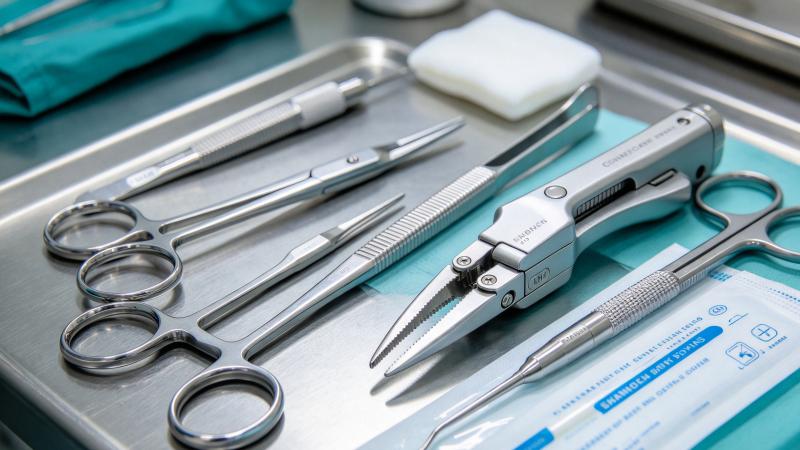
Teflon Coating for Medical Instruments: Specify the Material Before the Process
A coating system for medical instrument development cannot be selected reliably from a brand name alone. Teflon is a trademark associated with a range of fluoropolymer products, rather than a single universal coating formulation. A project described simply as Teflon coating may involve different materials, binders, solvents, and film-forming routes. Clarifying the actual supplied formulation is the first step toward a useful equipment discussion.
Turn a general request into a material specification
Identify the exact material grade and supplier documentation. Distinguish PTFE from other fluoropolymers and from binder-containing composite coatings. Record the delivery form, solids content, additives, and required processing sequence. The trademark does not imply that Cheersonic supplies a particular branded formulation or that an equipment configuration is licensed or certified for it.
Define the intended medical surface function, such as controlled friction, wetting, or another measurable requirement. Include coated regions, masked areas, allowable defects, and handling conditions. Medical polymer coatings must also be evaluated in the finished device context. A general industrial material description does not establish suitability for biological contact.
Evaluate ultrasonic spray as one process stage
An ultrasonic atomizing nozzle receives liquid at a controlled rate on a vibrating surface. Surface waves release droplets, and shaping gas can guide the spray toward the substrate. Programmed movement distributes formulation through repeated passes. The finished film develops through solvent removal and the selected material’s required curing or fusion process.
Ultrasonic spray may be evaluated for accessible medical components where controlled deposition is needed. Its feasibility depends on formulation, substrate, and geometry. Fine droplets do not guarantee complete recess coverage, and stable atomization does not establish final adhesion or continuity. The deposition and post-processing stages must work together.
Check geometry, wetting, and substrate compatibility
Complex shapes and thickness distribution
Curved surfaces, narrow features, corners, and fixture contacts can receive different loading. Assess controlled rotation or multiple orientations when appropriate. Precise coating thickness control requires local measurements across representative features. A satisfactory average can conceal thick transitions or bare sidewalls, especially when the geometry changes along the component.
Poor wetting and pinholes
Cleaning residues, processing oils, and variable surface treatment can cause patchy deposition or pinhole defects. Evaluate preparation on actual production substrates. Some formulations may require a compatible primer or another surface preparation step. These additions must be included in the complete material and biological evaluation rather than treated as invisible processing aids.
Solvent exposure and temperature can affect plastics, adhesives, and underlying coatings. Heat-sensitive substrates may not tolerate a formulation’s required film-forming schedule. Ultrasonic deposition does not make that schedule unnecessary. Confirm the actual material guidance before proposing a process for an assembled or flexible device.
Control formulation and final morphology
Viscosity variation can follow concentration, temperature, aging, and evaporation. For dispersions, settling or aggregation can also change delivered solids. Define preparation, mixing, hold time, and compatibility checks. Evaluate filtration without assuming it preserves the selected formulation. Early-run and late-run samples help reveal changes during operation.
Flow, speed, pass spacing, nozzle distance, gas, and thermal conditions interact. Too much wet loading may cause pooling; overly rapid evaporation may leave rough deposits. Coordinate post-curing or fusion with solvent removal and substrate limits. Assess film morphology, adhesion, and required function after the complete sequence.
Relevant downstream testing may include handling, bending, cleaning, or contact with adjacent parts. A low-friction material label does not establish durable device performance. Biocompatibility requirements also depend on formulation constituents, residues, finished configuration, and contact conditions, rather than on the brand name alone.
Prepare for repeatable manufacturing
Material utilization rate depends on geometry, targeting, masks, overspray, and extraction. Include startup delivery, fluid-path hold-up, flushing, unused formulation, and rejected samples in the material balance. A narrower spray may reduce certain losses without establishing a fixed efficiency or eliminating waste.
Nozzle clogging risk remains through dried polymer, aggregates, and contamination. Establish compatible cleaning and pause procedures and verify restart behavior. Production-line integration should coordinate part presentation, liquid delivery, extraction, drying or curing capacity, inspection, and the handling of interrupted components.
Batch-to-batch consistency requires repeated preparations and representative substrate lots. Assess parameter sensitivity around the preferred recipe and record the material grade used in each trial. If the supplied formulation changes, review whether additional evaluation is needed rather than assuming the existing recipe remains valid.
Frequently asked questions
Does Teflon always mean PTFE?
No. The brand covers multiple product types, so the exact material must be identified.
Can all branded coatings use one recipe?
No. Formulation and film-forming requirements can differ substantially.
Does spray quality establish medical suitability?
No. Finished-device functional and biological evaluation remains necessary.
What information should accompany a trial request?
Provide exact grade documentation, substrate samples, processing limits, coating function, and acceptance criteria.
Discuss a medical coating sample test
Qualified medical device manufacturers and R&D teams can contact Cheersonic to discuss material selection and arrange a coating sample test. Visit Cheersonic medical coating applications to begin a project-specific conversation.