
Structure of Guide Wire
In the world of minimally invasive intervention therapy, doctors often need to insert slender catheters into the complex vascular network or other deep cavities of the human body, directly reaching the lesion. The key guide to completing this difficult “adventure” is a seemingly simple yet intelligent thread – the guide wire. It is not only the “pioneer” for the advancement of the catheter, but also the “solid backing” that provides support.
Guidewire: a guide for the navigation of a catheter
Imagine that a catheter is like a ship that needs to navigate through a winding “river” (blood vessels). And the guide wire is the rope that explores the path, pulls the direction, and supports the smooth progress of the ship in front of it. Its core mission is to:
1. Guidance direction: Choose the correct path in the complex vascular branches to pave the way for subsequent catheters.
2. Provide support: Provide the necessary “skeleton” for the soft catheter to help it overcome resistance and reach the target position smoothly.

Anatomy guide wire: four core components
Although guide wires for different purposes have their own emphasis, they are generally composed of four key parts:
1. Skeleton (core): This is the “backbone” of the guide wire, which runs through the main body of the guide wire. Usually made of stainless steel or nickel titanium alloy with “memory” function, it determines the strength, flexibility, and pushing force of the guide wire. This skeleton itself is not uniformly thick from beginning to end, but is carefully designed into three sections:
*Shaping segment (head end): The front end is very soft and can be shaped into a specific curved shape by doctors, making it easy to “explore” and turn.
*Transition section (middle section): The diameter gradually narrows from the support section to the shaping section (conical taper), playing a role in force transmission and buffering.
*Support section (tail end): The thickest part that provides the main pushing force and bending resistance.
2. Head (tip): This is the part where the guidewire first contacts the blood vessel wall and the lesion, and its design directly affects the sensitivity of manipulation and the ability to pass through complex lesions. There are mainly two design concepts:
*Skeleton direct type: The skeleton material extends all the way to the tip. This design allows doctors to perceive the resistance ahead more clearly (with good tactile feedback), with strong pushing force and tracking path ability. The tip is relatively firm and suitable for crossing areas with high resistance.
*Flexible connection type: Connect a very soft metal strip (shaping wire) at the tip of the skeleton. This design makes the tip exceptionally soft and flexible, which can better conform to complex vascular shapes and reduce the risk of injury, but the pushing force and tactile feedback are relatively weak.
3. Outer garment (sheath): a protective layer wrapped around the skeleton (sometimes including the head). It has two important functions:
*Protection and manipulation: Protect the internal skeleton and affect the smoothness of the guide wire sliding in the blood vessels (tracking) and the tactile feedback of the doctor’s manipulation.
*Development (visibility): Materials that can be developed under X-rays (such as tungsten, platinum alloys, etc.) are often added to the sheath to allow doctors to clearly see the position of the guide wire on the screen. There are various types of sheaths, often used in combination:
*Metal coil sheath: provides good tactile feedback and development effect, but with slightly high friction, usually used for short sections that require precise positioning (such as a few centimeters at the tip).
*Polymer/plastic sheath: The surface is very smooth, greatly reducing friction and improving the smoothness of sliding inside blood vessels, but the tactile feedback will be weakened. Commonly used for longer sections (over ten centimeters) containing developing materials.

4. Coating: A “super smooth outer film” covering the surface of the guide wire (especially outside the sheath). This is the key “black technology” for the smooth passage of guide wires, mainly divided into two categories:
*Hydrophilic coating: This coating has the characteristic of “water absorption”. Once in contact with blood or physiological saline, it will quickly absorb water, forming a smooth hydrogel film on the surface of the guide wire, as if covered with a layer of “liquid lubricant”, significantly reducing friction resistance, allowing the guide wire to slide freely in the blood vessel, especially conducive to passing through narrow and tortuous lesions.
*Hydrophobic coating: This type of coating itself has a “hydrophobic” characteristic (such as polytetrafluoroethylene or certain special synthetic materials similar to non stick pan coatings), and will not bind with water. It reduces friction by forming a dense and smooth “wax like” structure on the surface of the guide wire. Although the lubrication method is different, it can still improve the passability of the guide wire.
*Common advantages: Both hydrophilic and hydrophobic coatings have stable chemical properties, good compatibility with the human body (biocompatibility), and are not prone to thrombosis, ensuring safety during use.
Smart Combination: The Art of Balancing Performance
The design of the guide wire is full of engineering wisdom:
*Skeleton thickness and length: A thick skeleton provides strong support and pushing force, but has poor flexibility; A thin skeleton is flexible and easy to track complex paths, but has weak support. The short transition section is well supported but the tip is prone to deformation; The long transition section has flexible handling but weak support. Designers carefully select these parameter combinations based on the characteristics of the target blood vessels and lesions.
*Sheath and coating combination: Different materials and lengths of sheaths (metal coils provide tactile sensation, polymers provide smoothness) are cleverly combined with different types of coatings (hydrophilic super smooth or hydrophobic anti friction) to complement each other’s strengths and weaknesses. The ultimate goal is to achieve optimal handling, passability, development, and safety of the guide wire in specific environments.
The seemingly slender guide wire is actually a fusion of material science, precision manufacturing, and ergonomics. From the tough and flexible skeleton, carefully designed head, various functional outerwear to smooth coating, every detail is aimed at the same goal: to help doctors reach lesions more safely and accurately, laying a solid foundation for the success of minimally invasive intervention therapy. They are silent yet crucial “explorers” and “explorers” within the blood vessels.
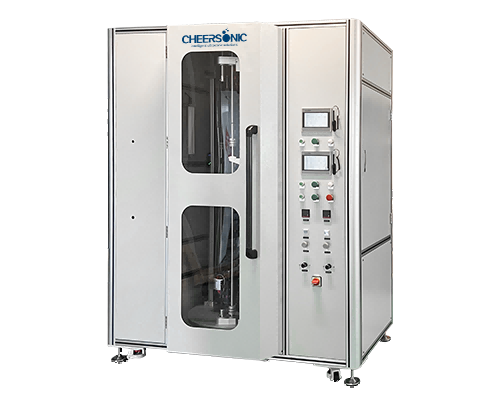
Ultrasonic spraying technology significantly reduces the resistance of wire pushing by precisely controlling the composite structure of PTFE and hydrophilic coating, while improving the durability and biocompatibility of the coating. Its high material utilization rate and strong process stability make it an ideal choice for medical guidewire manufacturing. Ultrasonic spraying equipment supports multi-layer coating stacking, which can sequentially spray buffer layer, drug layer, and anti-wear layer, achieving the triple functions of lubrication, drug loading, and durability. For braided tubes or guide wires with developing rings, the precision atomization and multi angle spraying ability of ultrasonic spraying can ensure uniform coating coverage, avoiding the problems of sagging and local excessive thickness in traditional processes. Meanwhile, the equipment maintenance cost is low, and the nozzle is not easily clogged, making it suitable for large-scale production.
About Cheersonic
Cheersonic is the leading developer and manufacturer of ultrasonic coating systems for applying precise, thin film coatings to protect, strengthen or smooth surfaces on parts and components for the microelectronics/electronics, alternative energy, medical and industrial markets, including specialized glass applications in construction and automotive.
Our coating solutions are environmentally-friendly, efficient and highly reliable, and enable dramatic reductions in overspray, savings in raw material, water and energy usage and provide improved process repeatability, transfer efficiency, high uniformity and reduced emissions.
Chinese Website: Cheersonic Provides Professional Coating Solutions
