
spraying Zebra guidewire surface drug coating
spraying Zebra guidewire surface drug coating – Cheersonic
Zebra guidewires, as core instruments in interventional urological procedures, rely on multi-layered functional coatings to achieve three core functions: smooth delivery, intraoperative visualization, and localized sustained drug release. The mainstream coatings on the market are divided into three categories: hydrophobic lubricating base coatings, hydrophilic lubricating coatings, and drug-releasing functional coatings. Traditional dip coating and high-pressure air spraying suffer from production pain points such as uneven coating thickness, drug molecule damage, raw material waste, and easy coating peeling, directly affecting the clinical safety and product yield of guidewires. Cheersonic ultrasonic medical spraying equipment, relying on low-frequency gentle atomization, multi-axis linkage rotary spraying, and micron-level thickness closed-loop control technology, is compatible with the spraying of coating solutions for all types of zebra guidewires. It can achieve layered composite coating, resulting in uniform, pinhole-free coatings, precise and controllable drug loading, and a material utilization rate exceeding 95%. It is suitable for the mass industrial production of nickel-titanium alloy zebra guidewires, effectively solving the challenges of interventional guidewire coating preparation processes.
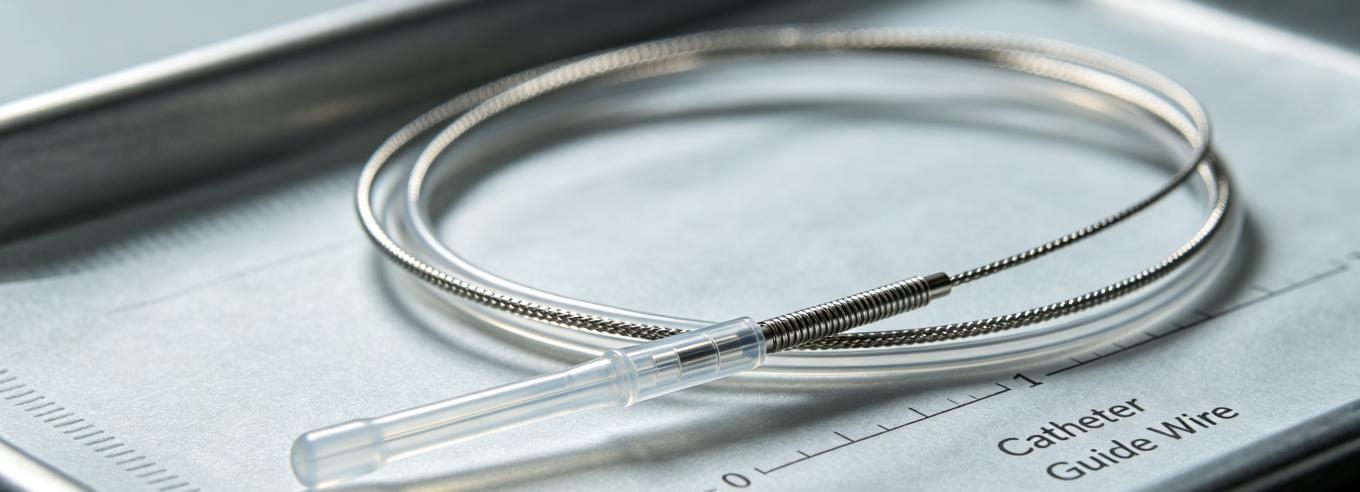
In minimally invasive interventional urological surgeries such as ureteral stones, urinary tract strictures, and percutaneous nephrolithotomy, zebra guidewires are fundamental consumables for establishing surgical channels, guiding catheters, and dilating lumens. The guidewire has a nickel-titanium shape memory alloy core covered by a blue and white striped PTFE sheath. It relies on a multi-layered composite functional coating to reduce lumen friction and achieve intraoperative visualization. Some therapeutic zebra guidewires are equipped with a drug-releasing coating to inhibit postoperative ureteral stricture and reduce inflammatory responses. Currently, mass-produced zebra guidewire surface coatings are mainly divided into three categories, with significant differences in performance and processing requirements among the different coatings.
The first type is a hydrophobic PTFE coating, which is also the signature stripe coating of the Zebra guidewire. PTFE has an extremely low coefficient of friction and excellent bioinertness, preventing direct contact between the metal core wire and human tissue, thus improving the overall guidewire delivery and tracking performance. Simultaneously, the addition of a contrast-enhancing filler creates the blue-white zebra stripe pattern, allowing for clear guidewire positioning under intraoperative X-ray. However, the PTFE coating solution has a high solids content and stringent film-forming requirements; traditional spraying methods are prone to stripe masking, localized buildup, and coating cracking.
The second type is hydrophilic lubricating coatings, with PVP (polyvinylpyrrolidone), PEG (polyethylene glycol), and polysaccharide polymers as the main raw materials. In a dry state, the coating is a solid film. Upon entering the body’s fluids, it quickly absorbs water to form a hydrogel layer, significantly reducing friction between the guidewire and the ureteral mucosa, thus minimizing the risk of tissue abrasion and bleeding caused by catheter insertion. However, the hydrophilic polymer chains are fragile, and high-pressure airflow spraying can easily break their molecular structure, directly weakening lubrication durability.
The third type is drug-release therapeutic coating, which is mostly used to prevent postoperative ureteral scar stenosis. The drug-carrying components are mainly suspensions of antiproliferative drugs such as paclitaxel and rapamycin, combined with biodegradable carrier polymers. Drug coatings require precise drug loading and a complete and continuous coating. If the coating thickness varies too much, local drug overdose or insufficient release may occur, causing clinical risks such as mucosal irritation and unstable efficacy. Therefore, the coating process has the highest requirements for precision.
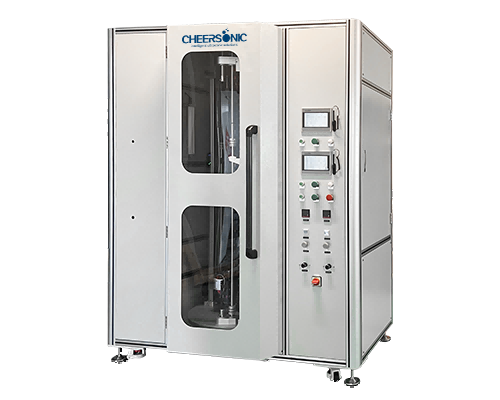
Traditional zebra guidewire coating preparation mainly relies on dip coating and high-pressure two-fluid spraying, which have inherent defects that are difficult to avoid: dip coating results in uneven coating thickness at the beginning and end of the guidewire, and excess solution dripping, requiring additional masking and cutting; high-pressure spraying relies on high-speed atomization of airflow, resulting in high droplet impact force, which can easily damage the structure of hydrophilic polymers and drug molecules, and the coating is prone to pinholes and peeling; paint splatter is serious, the material utilization rate is less than 30%, the cost of high-value drug raw materials is extremely high, the coating consistency between batches is poor, and the mass production yield is low.
Cheersonic Ultrasonic Medical Dedicated Spraying Equipment is specially developed for the slender cylindrical curved structure of zebra guidewires, and is perfectly compatible with the coating of all types of PTFE hydrophobic coatings, PVP hydrophilic coatings, and drug sustained-release composite coatings, which have multiple core advantages compared to traditional processes.
First, the atomization is gentle, protecting the coating and drug activity. The device relies on high-frequency ultrasonic vibration to atomize the liquid, eliminating the need for high-pressure airflow. The droplet size is stably controlled between 5 and 50 μm. Low-shear atomization does not break the polymer chains or damage the drug particle structure, fully preserving the hydrophilic lubrication properties and drug sustained-release effect. The adhesion between the coating and the PTFE substrate is greatly improved, and repeated pushing and pulling during the procedure does not easily cause peeling or flaking.
Secondly, it achieves micron-level precision thickness control and highly stable drug loading. Combined with a three-axis linkage motion platform and guide wire rotation fixture, the guide wire rotates at a uniform speed during spraying, and the nozzle moves longitudinally at a uniform speed, ensuring a coating thickness error within ±2μm. This enables ultra-thin, uniform film formation of 1–10μm. It also supports segmented selective spraying, applying the drug coating only to the shaping section at the guide wire tip, leaving no excess drug in the substrate stripe area, eliminating the need for a subsequent masking process and significantly improving production efficiency.
Thirdly, it boasts ultra-high material utilization, reducing production costs. Ultrasonic directional atomization reduces droplet splashing, achieving a coating utilization rate of over 95%. This significantly reduces the loss of suspensions of high-value drugs such as paclitaxel, leading to substantial reductions in raw material costs during long-term mass production. The equipment nozzles are less prone to clogging, making it suitable for low-flow, micro-volume continuous spraying, applicable to both laboratory research and mass production lines.
Fourthly, it features multi-layer composite continuous spraying, adaptable to integrated guidewire production. The equipment can be programmed with multiple spraying segments, sequentially completing the layering and overlapping of PTFE primer, hydrophilic lubricating layer, and drug sustained-release layer, forming a composite functional coating in one step. The entire machine cavity is constructed of corrosion-resistant stainless steel/titanium alloy, compatible with organic solvents, water-based polymers, and drug suspensions, conforming to the YY/T 1898 medical coating industry standard, and is highly adaptable to cleanrooms.
With the upgrading of the minimally invasive interventional consumables industry, therapeutic zebra guidewires with drug-release capabilities have become the market mainstream. Coating uniformity, biocompatibility, and mass production stability have become core competitive advantages for enterprises. Cheersonic ultrasonic spraying equipment, with its precise, gentle, and material-saving process characteristics, solves the pain points of traditional guidewire coating preparation, providing a standardized precision coating spraying solution for various interventional devices such as urinary zebra guidewires and vascular microguidewires.
About Cheersonic
Cheersonic is the leading developer and manufacturer of ultrasonic coating systems for applying precise, thin film coatings to protect, strengthen or smooth surfaces on parts and components for the microelectronics/electronics, alternative energy, medical and industrial markets, including specialized glass applications in construction and automotive.
Our coating solutions are environmentally-friendly, efficient and highly reliable, and enable dramatic reductions in overspray, savings in raw material, water and energy usage and provide improved process repeatability, transfer efficiency, high uniformity and reduced emissions.
If you have any technical questions, customization demands, or procurement inquiries about ultrasonic atomization nozzles, feel free to contact our professional sales and technical team for detailed parameters, customized solutions, and industry application support.
Email: market2@cheersonic.com
