
Limus-Based Coronary Drug-Eluting Stent Coating Technology
Limus-Based Coronary Drug-Eluting Stent Coating Technology: Complex Geometry Coverage, Drug-Polymer Systems, Coating Adhesion, and Drug Release
1. What Are Limus-Based Coronary Drug-Eluting Stents?
A drug-eluting stent (DES) is a vascular interventional medical device with a drug-containing coating applied to its surface.
In coronary interventions, drug-eluting stents typically combine the mechanical support of a metallic stent with local drug delivery.
Some drug-eluting stents incorporate limus-based antiproliferative drugs, including:
- Sirolimus.
- Everolimus.
- Zotarolimus.
- Other related drugs appropriate to a specific product design.
These drugs generally act through signaling pathways associated with cell proliferation.
Individual limus-based drugs differ in physicochemical properties, formulation requirements, and clinical applications.
Therefore, a coating process developed for one drug cannot automatically be transferred to another.
For medical device developers, a central challenge is forming a drug coating that meets design requirements on a complex stent structure while achieving appropriate mechanical stability and drug release behavior.

2. Why Is Coronary Stent Coating More Complex Than Flat-Surface Coating?
Coronary stents typically consist of multiple fine struts and connecting structures arranged in an open mesh-like geometry.
Unlike a flat substrate, a stent has outer surfaces, inner surfaces, sidewalls, strut edges, and connecting regions.
2.1 Outer Stent Surfaces
The outer stent surfaces generally face the vessel wall.
Their coating design may be closely related to local drug delivery requirements.
2.2 Inner Stent Surfaces
The inner surfaces face the blood flow.
Different products may use different coating designs, so whether the inner surface requires coating must be clearly defined.
2.3 Strut Sidewalls and Edges
Droplet deposition and drying behavior may differ at strut edges compared with flatter regions.
2.4 Stent Connecting Regions
Complex connector geometries may encourage local accumulation of drug or polymer.
2.5 Open Spaces Between Struts
If coating liquid accumulates across adjacent struts, undesirable coating bridges may form after drying.
Therefore, stent coating quality cannot be evaluated solely by total drug loading.
The actual distribution of drug and polymer across the complex geometry must also be investigated.
3. Key Technical Consideration One: Coating Coverage on Complex Stent Surfaces
Coating coverage and uniformity are important manufacturing quality attributes for limus-based drug-eluting stents.
3.1 Insufficient Coating Coverage
If certain target surfaces do not receive the required coating, local drug distribution may be affected.
3.2 Excessive Local Coating Thickness
Coating material may accumulate at strut edges or connecting regions.
Excessively thick areas can change surface morphology and mechanical behavior.
3.3 Coating Bridging
Coating bridging occurs when deposited material forms an unwanted connection across the open spaces between adjacent struts.
Such defects may affect stent geometry and subsequent mechanical behavior.
3.4 Circumferential Coverage Differences
A stent is a three-dimensional cylindrical mesh structure.
Unstable rotation or a mismatch between spray direction and stent geometry may cause circumferential coating variation.
3.5 How Should Coverage Be Evaluated?
Depending on the research objectives, optical microscopy, scanning electron microscopy, and other appropriate surface analysis methods may be used.
For quantitative projects, reproducible methods should be established to evaluate coverage, thickness, or other spatial distribution characteristics.
4. Key Technical Consideration Two: Limus-Based Drug and Polymer Coating Systems
Many drug-eluting stents use coatings that combine a drug with a polymer.
The polymer may serve as a drug carrier, influence coating mechanical properties, and affect drug release behavior.
However, not all drug-eluting stents use the same polymer architecture.
Polymer-free and other specialized coating designs also exist.
4.1 Drug-Polymer Compatibility
The drug must have appropriate compatibility with the selected polymer and solvent system.
Undesirable phase separation during formulation preparation or drying may affect coating uniformity and drug release.
4.2 Role of the Polymer
Depending on the product design, the polymer may influence:
- Drug distribution within the coating.
- Coating adhesion.
- Coating mechanical properties.
- Drug diffusion and release.
- Coating stability in physiological environments.
4.3 Different Polymer Systems
Drug-eluting stents may use durable polymers, biodegradable polymers, or other coating designs.
These systems can differ in drug release behavior, material changes, and long-term characteristics.
The specific selection should be based on product objectives and appropriate validation results.
4.4 Influence of Solvents
Solvents influence the dissolution or dispersion of drugs and polymers, as well as wetting and drying behavior.
Therefore, the solvent is not merely a processing medium.
It is also an important variable in coating process development.
5. Key Technical Consideration Three: Coating Thickness and Drug Loading
Coating thickness and drug loading must be controlled according to the stent design.
5.1 Why Is Coating Thickness Important?
Coating thickness may influence:
- Stent surface morphology.
- Total drug content.
- Drug release pathways.
- Coating mechanical response.
- Coating condition after stent crimping and expansion.
However, the relationship between coating thickness and drug release is not necessarily linear.
5.2 Drug Loading Versus Polymer Loading
For drug-polymer composite coatings, drug content must be distinguished from total coating mass.
Two samples with similar total coating masses may have different release behavior because of differences in drug-to-polymer ratio.
5.3 How Can Deposition Be Controlled?
In spray coating processes, researchers can investigate coating solution concentration, liquid delivery rate, stent rotation speed, scanning speed, and number of spray passes.
However, actual drug loading must still be measured using appropriate analytical methods.
6. Key Technical Consideration Four: Stent Coating Adhesion
Drug-eluting stents may undergo several mechanical operations during manufacturing and use.
Insufficient adhesion between the coating and stent surface can lead to delamination or local damage.
6.1 Factors Affecting Coating Adhesion
Potential factors include:
- Stent substrate material.
- Surface cleanliness.
- Surface oxide layers and other surface characteristics.
- Polymer composition.
- Coating thickness.
- Drying conditions.
- Internal coating stresses.
6.2 Why Is Adhesion Not the Only Requirement?
The coating must not only adhere to the stent surface but also maintain acceptable integrity after mechanical deformation.
Some coatings may exhibit adequate initial adhesion yet develop cracks during stent expansion.
Therefore, adhesion and mechanical durability should be evaluated separately.
7. Key Technical Consideration Five: Coating Integrity During Stent Crimping and Expansion
Coronary stents are typically crimped onto a delivery system and expanded at the target location.
These operations can expose the stent struts and coatings to substantial mechanical deformation.
7.1 Crimping
Crimping may expose the coating to compression, friction, or local contact forces.
If the coating’s mechanical properties are unsuitable, damage may occur.
7.2 Stent Expansion
During expansion, the geometry of struts and connecting regions changes.
The coating must accommodate the resulting mechanical deformation.
7.3 Potential Coating Defects
- Coating cracks.
- Local delamination.
- Coating particle shedding.
- Edge damage.
- Local coating accumulation or deformation.
7.4 How Should Coating Integrity Be Evaluated?
Coating morphology and mechanical integrity should be evaluated under crimping, delivery, and expansion conditions appropriate to the device design.
Visual inspection of an untreated stent alone cannot adequately represent coating behavior during subsequent use.
8. Key Technical Consideration Six: Drug Release Behavior of Limus-Based Coatings
Drug release is an important functional characteristic of drug-eluting stents.
For drug-polymer coating systems, release behavior may be influenced by drug properties, polymer structure, coating thickness, and environmental conditions.
8.1 Drug Release Versus Drug Loading
Drug loading describes how much drug is present in the stent.
Drug release describes how the drug leaves the coating over time under defined conditions.
These properties are related but are not the same.
8.2 Factors Influencing Drug Release
Potential factors include:
- Drug distribution within the polymer.
- Drug-polymer compatibility.
- Coating thickness.
- Polymer physicochemical characteristics.
- Coating microstructure.
- Drug solid-state properties.
- Test medium and environmental conditions.
8.3 Initial and Subsequent Drug Release
Some drug coatings may exhibit a relatively pronounced initial release phase followed by different release behavior over time.
The actual release profile depends on the product design and coating system.
Not all limus-based drug-eluting stents have the same release mechanism or time profile.
8.4 How Should Drug Release Be Evaluated?
Appropriate in vitro drug release methods can be used to investigate drug release at different time points and cumulative release behavior.
However, an in vitro release profile is not directly equivalent to in vivo drug distribution or clinical effectiveness.
It must be interpreted together with other relevant evidence.
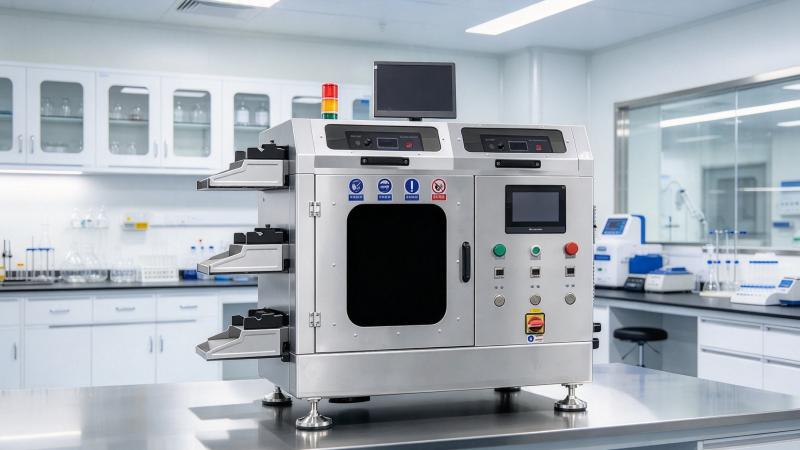
9. Application of Ultrasonic Spray Coating to Limus-Based Stent Coatings
Ultrasonic spray coating is a technology that can be investigated for precision drug coating process development.
It uses an ultrasonic nozzle to atomize a suitable coating solution and controlled gas flow to transport droplets toward the stent surface.
For coronary stents, precision liquid delivery, stent rotation, and nozzle scanning can be combined to investigate different deposition conditions.
9.1 Precision Liquid Delivery
Supports investigation of different drug and polymer deposition amounts.
9.2 Stent Rotation
Supports research into circumferential coating coverage.
9.3 Programmable Nozzle Scanning
Supports investigation of deposition distribution along the stent length.
9.4 Multiple Thin-Layer Spray Passes
Allows comparison of different spray pass numbers and intermediate drying conditions.
9.5 Process Repeatability
Recording liquid delivery, rotation, scanning, and drying conditions supports comparison between samples.
9.6 Technical Limitations
Ultrasonic spray coating does not automatically guarantee completely uniform coverage of inner and outer stent surfaces.
It also cannot guarantee the absence of coating bridging or local accumulation.
Compatibility with different stent geometries must be confirmed through actual sample trials.
10. Coating Quality Evaluation for Limus-Based Drug-Eluting Stents
| Evaluation Item | Main Objective |
|---|---|
| Drug loading | Confirm actual drug content |
| Polymer loading | Evaluate polymer deposition amount |
| Coating thickness | Investigate thickness and local variation |
| Surface coverage | Evaluate coating on intended stent surfaces |
| Coating bridging | Identify undesirable connections between struts |
| Coating adhesion | Assess bonding to the stent substrate |
| Post-crimping integrity | Evaluate effects of manufacturing and delivery-related mechanical forces |
| Post-expansion integrity | Evaluate coating condition after stent deformation |
| Drug release | Investigate drug release behavior |
| Coating stability | Evaluate changes during storage and relevant handling |
| Process repeatability | Compare consistency across samples and batches |
11. How to Develop a Limus-Based Drug-Eluting Stent Coating Process
For R&D customers, the following development workflow is recommended.
Stage 1: Drug and Polymer Formulation Research
Confirm compatibility between the drug, polymer, and solvent system.
Stage 2: Spray Feasibility Testing
Investigate whether the coating solution can be delivered and atomized consistently.
Stage 3: Stent Surface Coating Trials
Investigate the influence of stent rotation, scanning, and number of spray passes on coating coverage.
Stage 4: Coating Structure Evaluation
Analyze drug loading, coating thickness, coverage, and surface defects.
Stage 5: Mechanical Integrity Testing
Evaluate the effects of crimping and expansion on the coating.
Stage 6: Drug Release Testing
Investigate the release behavior of candidate coatings.
Stage 7: Process Repeatability Confirmation
Use multiple samples to verify the stability of the candidate process.
If the customer later intends to use the process for regulated medical device manufacturing, appropriate equipment qualification, process validation, and product evaluation will be required under the applicable regulations and quality management system.
12. Cheersonic Ultrasonic Drug-Eluting Stent Coating Equipment Solutions
For customers developing sirolimus-, everolimus-, and other limus-based drug-eluting stents, Cheersonic ultrasonic spray coating equipment can be considered as a candidate platform for precision drug coating R&D.
Equipment configurations can be discussed according to:
- Coronary stent length and diameter.
- Stent strut geometry.
- Drug and polymer formulation.
- Solvent system.
- Target drug loading.
- Coating coverage requirements.
- Stent rotation and scanning arrangements.
- Drying and environmental control.
- R&D sample quantities and prototype production requirements.
Process trials using actual stent samples and coating formulations can help determine the suitability of ultrasonic spray coating for drug deposition on complex stent surfaces.
Learn more about Cheersonic coating equipment solutions:
https://cheersonic-liquid.com/en/ultrasonic-coating-equipment-solutions/
Conclusion
Limus-based coronary drug-eluting stent coating development involves precision deposition on complex geometries, drug-polymer formulation design, coating mechanical stability, and drug release control.
For researchers, uniform coating coverage is only one aspect of the development process.
Drug loading, polymer distribution, adhesion, coating integrity after crimping and expansion, and drug release behavior must all be verified through appropriate experiments.
Ultrasonic spray coating equipment can provide an adjustable deposition platform for stent coating R&D, but final process suitability must be determined through comprehensive material analysis, mechanical testing, and drug release evaluation.
