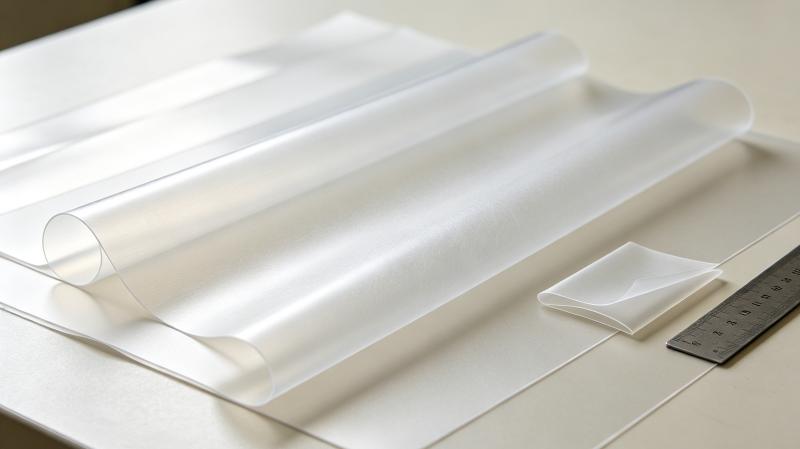
CYTOP is an amorphous fluoropolymer used in thin-film applications where properties such as transparency, electrical insulation, or water repellency are relevant. For a development team, the material name is only the starting point. The selected grade, solvent system, substrate, and thermal process determine whether a usable coating can be produced. Evaluating a polymer coater therefore requires a formulation-specific trial rather than assuming every fluoropolymer solution behaves alike.
Define the coating task before choosing settings
Identify whether the project needs an insulating film, a surface with controlled water interaction, or another functional layer. Define dry-film thickness distribution, permitted defects, adhesion, optical requirements where applicable, and downstream processing. A film that passes a visual inspection may still have local defects that affect its intended function.
CYTOP is a material trade name, not a Cheersonic equipment specification. Use the current material supplier’s instructions and safety information for the exact grade. Its specialized solvent requirements make compatibility assessment particularly important. Do not substitute a general-purpose solvent or a process developed for an unrelated polymer without evaluating the consequences.
What ultrasonic spray coating contributes
An ultrasonic spray system delivers formulation to a vibrating atomizing surface. Vibration-driven liquid waves generate droplets, and a shaping gas stream can guide them toward the substrate. Controlled movement distributes the spray through successive passes. Solvent removal then converts deposited liquid into a polymer film; any further thermal conditioning must follow the material-specific process requirements.
For thin films on accessible flat or moderately shaped surfaces, this approach offers a practical way to vary deposition incrementally. It does not establish compatibility or final performance by itself. A stable spray plume is useful evidence of atomization, but not proof of complete coverage, suitable morphology, or electrical quality.
Screen compatibility and formulation stability
Check the complete liquid path
Assess solvent compatibility with tubing, seals, filters, reservoirs, nozzle components, and waste collection materials. Include the cleaning fluid as well as the coating formulation. Equipment suitability must be confirmed for the intended chemical exposure and operating conditions. A trial should also consider extraction and safe handling based on the formulation’s safety documentation.
Control viscosity variation
Changes in concentration, solution temperature, or solvent loss can alter viscosity and delivery. Establish preparation and storage instructions and measure under repeatable conditions. Record solution age and bottle-opening history where evaporation could be significant. Observe whether the spray changes between the beginning and end of a run rather than inspecting only the initial sample.
Develop wetting and drying together
Substrate wetting is a key source of film variation. Surface residues, inconsistent cleaning, and material differences can produce isolated deposits or dewetting. Pinholes may remain even when average deposited mass appears correct. Test on the intended substrate and evaluate whether the solvent affects underlying layers, adhesives, or polymer components.
Uneven film thickness can result from pass overlap, edge accumulation, or nonuniform evaporation. Avoid transferring a drying schedule from another coating method without trials. The material supplier’s CYTOP technical guidance cautions that retained solvent during high-temperature baking can contribute to surface and thickness defects. Establish an appropriate staged process for the actual film and substrate rather than using a universal temperature recipe.
Inspect film morphology after the complete thermal sequence. Map thickness over the useful area and examine edges separately. Add electrical, optical, or wetting measurements according to the intended application. If several layers are deposited, assess how each new pass interacts with the previous layer.
Account for waste and nozzle condition
Overspray, masking, startup delivery, and cleaning contribute to material waste. Targeted spraying may improve capture in a suitable configuration, but no fixed savings should be assumed. Compare consumption against accepted coated area or accepted parts. Include rejected samples when assessing whether a narrower process window is economically practical.
Nozzle clogging risk includes dried polymer deposits and contamination in the liquid path. Ultrasonic vibration does not make the system maintenance-free. Develop a compatible flushing method and test pause-and-restart behavior. Residue on the atomizing surface can change spray distribution before a complete blockage becomes visible.
Prepare for production-line integration
Assess sensitivity to flow, motion speed, nozzle distance, gas settings, and thermal conditions. Batch-to-batch inconsistency may involve both solution preparation and substrate supply. Production transfer should include controlled fixtures, extraction, drying residence, recipe records, and inspection. Confirm performance across repeated preparations and representative line interruptions.
Frequently asked questions
Can any CYTOP grade use the same spray recipe?
No. Grade, concentration, solvent composition, substrate, and film requirements need separate evaluation.
Does a hydrophobic surface prove electrical quality?
No. Water interaction and electrical insulation are different properties and require appropriate tests.
Is the highest drying temperature the best choice?
No. Solvent removal, material guidance, and substrate limits must determine the thermal sequence.
What should a trial request include?
Provide the exact grade, formulation documentation, substrate samples, required film function, and acceptance criteria.
Discuss your coating development project
Qualified manufacturers and R&D teams can contact Cheersonic to discuss polymer coater suitability and arrange a coating trial test. Review Cheersonic coating applications and share the material and substrate details needed for a focused evaluation.