
Paclitaxel-Coated Balloon Technology
Paclitaxel-Coated Balloon Technology: Drug Loading, Coating Uniformity, Balloon Folding and Inflation, Drug Transfer, and Particle Shedding
1. What Is a Paclitaxel-Coated Balloon?
A paclitaxel-coated balloon (PCB) is a vascular interventional medical device with a paclitaxel-containing coating applied to the surface of its balloon catheter.
It belongs to the broader category of drug-coated balloon (DCB) technologies.
Unlike conventional balloon angioplasty, drug-coated balloon technology combines the mechanical action of balloon inflation with the intended delivery of a drug to the target tissue.
Paclitaxel is an antiproliferative drug.
In certain vascular interventional applications, paclitaxel coatings have been developed to inhibit excessive vascular smooth muscle cell proliferation.
One characteristic of drug-coated balloons is that they generally do not leave behind a permanent metallic stent structure at the treatment site.
However, this does not mean that drug-coated balloons are suitable for every vascular lesion.
The intended use, clinical benefits, and risks of a particular device must be evaluated according to its approved indications and supporting clinical evidence.
For medical device manufacturers, the development challenge is not simply to apply paclitaxel to the balloon surface.
It is to produce a coating that meets the intended requirements throughout manufacturing, folding, delivery, and balloon inflation.
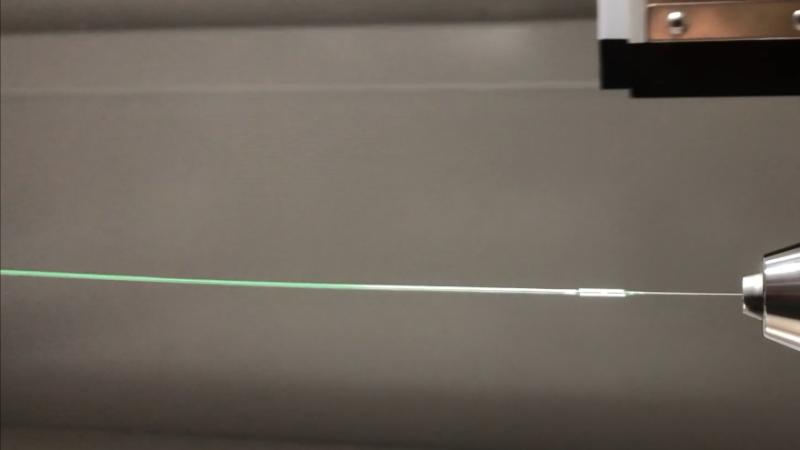
2. What Does a Paclitaxel Balloon Coating Typically Contain?
A paclitaxel balloon coating is not necessarily a film made entirely of pure drug.
Depending on the product design, it may contain:
- Paclitaxel as the active pharmaceutical ingredient.
- Excipients that influence coating structure or drug transfer.
- Appropriate film-forming or interfacial functional components.
- Solvents used during manufacturing, with residual levels requiring control.
Different formulations may produce different drug solid-state forms, surface morphologies, and mechanical properties.
For example, drug crystallinity, particle size, and interactions with excipients may influence retention on the balloon and subsequent drug transfer.
Therefore, final balloon coating quality cannot be determined from paclitaxel content alone.
3. Key Technical Consideration One: Controlling Paclitaxel Drug Loading
Drug loading is a critical quality attribute in paclitaxel-coated balloon development.
It is often expressed as drug mass per unit surface area.
However, the specific surface area definition, calculation of the effective coated area, and target loading must be established according to the product design.
3.1 Why Is Drug Loading Important?
If actual drug loading deviates from the design target, product consistency and intended drug delivery performance may be affected.
Higher drug loading should not automatically be considered better.
Additional drug may alter coating structure, mechanical stability, and particle shedding behavior.
3.2 What Factors Affect Actual Drug Loading?
In a spray coating process, relevant factors may include:
- Paclitaxel concentration in the coating formulation.
- Actual coating solution delivery volume.
- Balloon rotation speed.
- Relative movement between the nozzle and balloon.
- Number of spray passes.
- Spray deposition efficiency.
- Drug loss during drying and subsequent processing.
Importantly, the total drug mass delivered by the equipment is not equal to the amount ultimately retained on the balloon.
3.3 How Should Drug Loading Be Evaluated?
Researchers should use an appropriate, validated analytical method to measure actual drug content on the balloon.
During process development, differences between individual samples and batches should also be evaluated.
For drug-coated balloons, an acceptable average drug loading does not necessarily demonstrate uniform local distribution.
Drug loading and spatial distribution should therefore be assessed separately.
4. Key Technical Consideration Two: Coating Uniformity on the Balloon Surface
A balloon catheter is not a flat substrate.
It has a cylindrical curved surface, shoulders, end regions, and, in some designs, complex folded structures.
These geometric features make uniform drug coating challenging.
4.1 Circumferential Coating Uniformity
Different circumferential positions must receive coatings that meet the design requirements.
If balloon rotation is unstable or spray distribution is not appropriately matched to rotation speed, local accumulation or insufficient coverage may occur.
4.2 Axial Coating Uniformity
Drug distribution along the balloon length is also important.
During spraying, nozzle movement speed, spray width, and scanning path may influence axial coating distribution.
4.3 Balloon Shoulders and End Regions
Changes in geometry at the balloon shoulders may influence droplet deposition and drying.
If these regions require specific coating coverage, their quality should be evaluated separately.
4.4 Coating Uniformity Is Not the Same as Drug Transfer
Uniform drug distribution supports manufacturing consistency, but coating appearance alone cannot establish drug transfer performance.
Drug transfer also depends on drug solid-state properties, excipient composition, contact conditions, and other factors.
5. Key Technical Consideration Three: Coating Integrity During Balloon Folding
Drug-coated balloons may undergo folding, protective handling, and other mechanical operations during manufacturing and use.
Folding changes the local geometry of the balloon surface and may expose the coating to bending, compression, or friction.
5.1 Why Can Folding Affect the Coating?
After formation, the coating may have mechanical properties different from those of the balloon substrate.
When the balloon deforms, the coating may exhibit:
- Local cracking.
- Coating redistribution.
- Drug particle detachment.
- Local coating accumulation.
- Separation from the balloon surface.
The occurrence and severity of these effects depend on the formulation, coating structure, and actual mechanical conditions.
5.2 Should Coating Be Applied Before or After Balloon Folding?
There is no universal answer for every drug-coated balloon product.
Different devices may use different manufacturing sequences and coating configurations.
The choice of coating before or after folding must consider balloon geometry, intended drug distribution, folding operations, and final device performance.
5.3 How Should Coating Integrity After Folding Be Evaluated?
Coating morphology, drug retention, and particle shedding can be compared before and after representative manufacturing or simulated-use operations.
Visual inspection alone is insufficient to establish coating integrity.
Appropriate analytical and functional testing is also required.
6. Key Technical Consideration Four: Coating Changes During Balloon Inflation
Balloon inflation is a critical step in the intended use of drug-coated balloons.
During inflation, the balloon contacts the target vessel wall while the coating may undergo mechanical deformation, fluid exposure, and drug transfer.
6.1 How Can Inflation Affect the Coating?
Inflation may change local stresses and coating structure on the balloon surface.
Different formulations may exhibit different cracking, detachment, or drug release behavior.
6.2 Why Is Simulated Inflation Testing Important?
Measuring drug loading on an unused balloon does not fully represent its drug delivery performance.
Researchers need suitable simulated-use tests to evaluate coating changes during inflation.
6.3 Which Results Should Be Evaluated?
Important outcomes may include:
- Drug retention before and after inflation.
- Changes in coating morphology.
- Drug transfer into an appropriate target model.
- Particle release.
- Coating changes in different balloon regions.
7. Key Technical Consideration Five: Paclitaxel Drug Transfer
Drug transfer is an important functional characteristic of paclitaxel-coated balloons.
The coating must support the intended transfer of drug from the balloon surface into target tissue or an appropriate experimental model under defined contact conditions.
7.1 What Factors Influence Drug Transfer?
Potential factors include:
- Paclitaxel solid-state form.
- Interactions between drug and excipients.
- Coating surface structure.
- Balloon contact conditions.
- Simulated-use environment.
- Drug loss during delivery.
7.2 Is Stronger Coating Adhesion Always Better?
Not necessarily.
The coating needs to retain sufficient drug during delivery while enabling the intended transfer at the treatment site.
Therefore, maximizing adhesion alone may not reflect the full functional requirements of the balloon coating.
7.3 How Can Drug Transfer Be Evaluated?
Testing methods should be appropriate to the product development stage and intended use.
For example, researchers may investigate changes in balloon drug content before and after simulated use, together with drug transfer into an appropriate receiving model.
However, a reduction in drug content on the balloon does not necessarily mean successful transfer to the target tissue.
Drug may also be lost into other parts of the test environment.
8. Key Technical Consideration Six: Drug Particle Shedding
Particle shedding is an important quality and safety concern for paclitaxel-coated balloons.
During balloon delivery, contact, and inflation, some coating material may detach in particulate form.
The number, size, composition, and conditions of particle release may all be relevant to risk assessment.
8.1 What Factors Can Cause Particle Shedding?
- Drug crystals and coating microstructure.
- Interactions between the coating and balloon substrate.
- Excessive local coating thickness.
- Coating brittleness after drying.
- Balloon folding and inflation.
- Mechanical interactions during device delivery.
8.2 How Can Undesirable Particle Shedding Be Reduced?
Research may focus on coating formulation, deposition uniformity, drying processes, and mechanical handling conditions.
However, no particular spray coating technology should be assumed to eliminate particle shedding automatically.
8.3 How Should Particle Shedding Be Tested?
Particle number, size distribution, and other risk-relevant characteristics should be evaluated under appropriate simulated-use conditions.
Where necessary, particle shedding results should be interpreted together with drug retention and drug transfer data.
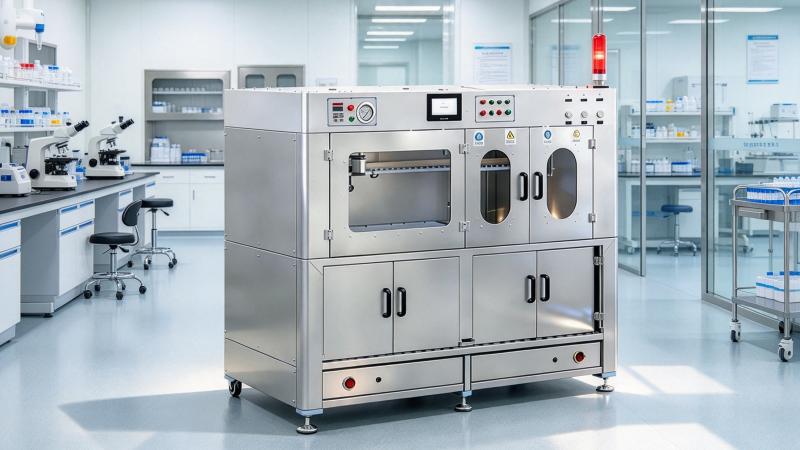
9. Application of Ultrasonic Spray Coating to Paclitaxel-Coated Balloons
Ultrasonic spray coating uses an ultrasonic nozzle to atomize a suitable drug coating formulation.
A controlled gas flow directs the droplets toward the balloon surface.
In an R&D system, balloon rotation, precision liquid delivery, and axial nozzle scanning can be combined to investigate controlled deposition.
Potential Process Capabilities
Precision liquid delivery: Supports investigation of drug loading under different delivery conditions.
Controlled rotation: Supports investigation of circumferential drug distribution.
Programmable scanning: Supports investigation of axial coating uniformity.
Multiple thin-layer deposition: Allows comparison of spray passes and drying strategies.
Parameter recording: Supports comparison between research experiments.
Technical Limitations That Must Be Validated
Ultrasonic spray coating does not automatically guarantee accurate drug loading, adequate coating adhesion, or reduced particle shedding.
These characteristics must be evaluated using the actual paclitaxel formulation, balloon substrate, and simulated-use conditions.
10. Recommended Testing for Paclitaxel Balloon Coatings
| Evaluation Item | Main Objective |
|---|---|
| Drug loading | Confirm actual drug content |
| Coating uniformity | Evaluate spatial drug distribution |
| Coating morphology | Identify cracks, aggregation, and local accumulation |
| Drug solid-state properties | Investigate crystalline and other solid-state characteristics |
| Folding durability | Evaluate the effects of manufacturing operations |
| Post-inflation coating condition | Assess changes during simulated use |
| Drug retention | Investigate drug loss during delivery and handling |
| Drug transfer | Evaluate delivery into an appropriate target model |
| Particle shedding | Assess particle release and related risks |
| Process repeatability | Compare consistency across samples and batches |
11. Cheersonic Ultrasonic Drug-Coated Balloon Equipment Solutions
For companies developing paclitaxel-coated balloons, Cheersonic ultrasonic spray coating equipment can be considered as a candidate platform for drug deposition process development and optimization.
Through precision liquid delivery, balloon rotation, programmable scanning, and suitable drying configurations, researchers can investigate how different process conditions affect coating quality.
Customers are encouraged to provide balloon dimensions, materials, drug formulation, target loading, and existing coating challenges to support equipment compatibility assessment.
Learn more about Cheersonic coating equipment solutions:
https://cheersonic-liquid.com/en/ultrasonic-coating-equipment-solutions/
Conclusion
The development of paclitaxel-coated balloons combines drug formulation, materials science, precision coating, and medical device performance evaluation.
Drug loading and coating uniformity are important manufacturing attributes, but they do not independently determine final balloon performance.
Coating integrity during folding and inflation, drug transfer, and particle shedding must also be evaluated through systematic development testing.
Ultrasonic spray coating equipment can provide a controlled deposition method for coating process development, while final product quality requires comprehensive analytical, functional, and safety evaluation.