
Ultrasonic Drug Eluting Balloon Coating Machine: How to Optimize Paclitaxel-Based Coatings on Balloon Catheters
1. Why Do Paclitaxel-Based Drug-Coated Balloons Require Process Optimization?
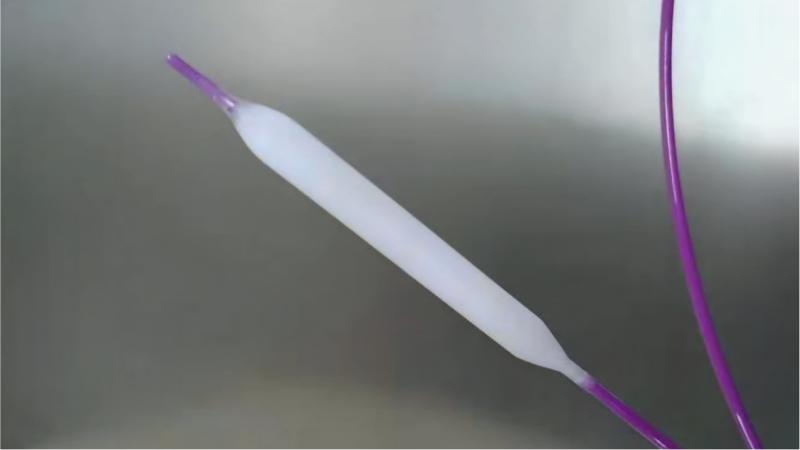
Paclitaxel-coated balloons (PCBs) represent an important area of drug-coated vascular interventional device development.
The coating process must do more than deposit paclitaxel onto the balloon surface.
It must also account for coating behavior during manufacturing, device delivery, and balloon inflation.
For developers, coating optimization typically involves several interrelated objectives:
- Achieving the intended drug loading.
- Improving consistency of drug distribution across the balloon.
- Controlling undesirable coating defects.
- Investigating drug retention during delivery.
- Evaluating drug transfer during balloon inflation.
- Assessing particle shedding.
- Improving process repeatability.
These objectives may involve trade-offs.
For example, stronger coating adhesion may help reduce drug loss during delivery but does not necessarily improve drug transfer to the target tissue.
Therefore, optimization should not focus on a single quality attribute.
2. Working Principle of an Ultrasonic Drug Eluting Balloon Coating Machine
An Ultrasonic Drug Eluting Balloon Coating Machine is an ultrasonic spray coating system used to investigate precision drug deposition onto balloon catheter surfaces.
Its basic operating process includes:
- Delivering a suitable paclitaxel-based coating formulation to an ultrasonic nozzle.
- Atomizing the liquid through ultrasonic vibration.
- Directing droplets toward the balloon surface using controlled gas flow.
- Coating the target region through balloon rotation and relative nozzle movement.
- Investigating single or multiple coating passes.
- Forming the drug coating through an appropriate drying process.
The equipment controls coating solution delivery and deposition conditions.
Actual drug loading, coating structure, and functional performance must still be confirmed through independent testing.
3. Optimization Objective One: Paclitaxel Drug Loading
Drug loading is an important quality attribute in paclitaxel-coated balloon development.
It is commonly described as the mass of drug per unit surface area.
However, the definition and calculation of balloon surface area must remain consistent with the specific product design and analytical method.
Factors Affecting Drug Loading
- Paclitaxel concentration in the coating formulation.
- Liquid delivery rate.
- Balloon rotation speed.
- Nozzle scanning speed.
- Number of spray passes.
- Actual deposition efficiency.
- Material loss during drying and subsequent processing.
Optimization Approach
Researchers can investigate how changes in process parameters influence actual drug loading.
However, the total amount of drug sprayed must not be assumed to equal the amount retained on the balloon surface.
Actual loading should be measured using an appropriately validated drug analysis method.
For different balloon sizes, the relationship between drug loading and effective coated area must also be evaluated.
4. Optimization Objective Two: Coating Uniformity on the Balloon Surface
Balloon catheters have three-dimensional curved surfaces.
Even with stable nozzle output, drug deposition may differ across the balloon.
4.1 Circumferential Uniformity
Balloon rotation speed may influence deposition at different circumferential positions.
The relationship between rotation speed and coating delivery must be investigated.
4.2 Axial Uniformity
Nozzle movement along the balloon length affects axial coating distribution.
Scanning speed and spray coverage should be adjusted together.
4.3 Balloon Shoulders and End Regions
The shoulders and ends of a balloon have different geometric characteristics from the main cylindrical region.
These areas may experience insufficient coverage or local accumulation.
Whether special treatment is required depends on the product design and coating specifications.
4.4 Multiple Thin-Layer Deposition
Multiple coating passes can be investigated as a method of improving coating distribution.
However, subsequent droplets may rewet previously deposited layers and change drug distribution.
Therefore, multiple-pass spraying should be evaluated together with intermediate drying conditions.
5. Optimization Objective Three: Drying and Paclitaxel Solid-State Properties
The final properties of paclitaxel-based coatings may be influenced by solvent evaporation and drying conditions.
Important considerations include drug crystallinity, surface morphology, and interactions with excipients.
Potential Problems Associated with Rapid Drying
Certain formulations may develop uneven local deposits, surface roughness, or other undesirable microstructures.
Potential Problems Associated with Slow Drying
Wet coatings may flow, redistribute, or accumulate locally.
Key Optimization Considerations
Researchers can investigate the effects of drying temperature, airflow, drying time, and intervals between spray passes.
However, drug solid-state properties cannot be determined from visual appearance alone.
Appropriate analytical techniques may be required to investigate crystalline or amorphous drug forms.
Residual solvents, drug stability, and balloon material compatibility should also be considered.
6. Optimization Objective Four: Drug Retention During Device Delivery
Drug-coated balloons may undergo folding, protective handling, delivery, and other mechanical operations before use.
These processes can affect coating integrity.
Researchers typically investigate how much drug remains on the balloon under representative simulated-use conditions.
Important Questions
- Does the coating show local detachment?
- Are undesirable particles generated?
- Do folded regions exhibit significant coating changes?
- Does drug loading after simulated delivery meet the intended requirements?
How Can Ultrasonic Spray Coating Support Optimization?
Different deposition strategies and drying conditions can be investigated to compare the mechanical behavior of resulting coatings.
However, the spraying process alone does not determine drug retention.
Excipients, drug solid-state properties, and balloon materials are also important.
7. Optimization Objective Five: Drug Transfer During Balloon Inflation
An important difference between drug-coated balloons and drug-eluting stents is that balloon-based drug delivery generally occurs during a relatively short contact period.
The coating must therefore support the intended drug transfer under defined balloon contact conditions.
Why Does Uniform Coating Not Necessarily Mean Good Drug Transfer?
Even a uniformly distributed coating may exhibit different drug transfer characteristics depending on drug form, excipient composition, and coating adhesion.
Factors to Investigate
- Drug and excipient composition.
- Coating surface morphology.
- Drug solid-state properties.
- Balloon contact and inflation conditions.
- Drug loss during simulated use.
- Drug transfer into the target tissue or an appropriate model.
Ultrasonic spray coating can help investigate how deposition parameters affect coating structure.
However, drug transfer must be evaluated through suitable functional tests.
8. Optimization Objective Six: Particle Shedding and Coating Integrity
Paclitaxel-based balloon coatings may contain particulate or other solid-state structures.
Some coating material may detach during device handling or use.
Particle shedding is therefore an important quality and safety consideration.
Factors That May Influence Particle Shedding
- Drug and excipient composition.
- Coating thickness and local distribution.
- Microstructure after drying.
- Interaction between the coating and balloon surface.
- Balloon folding and inflation.
- Subsequent packaging and handling.
Process Optimization Approach
Researchers can compare particle shedding behavior from coatings prepared using different spraying conditions under representative simulated-use conditions.
However, a particular spraying method should not be claimed to reduce particle shedding without supporting test data.
9. How to Establish a Paclitaxel Balloon Coating Optimization Study
A staged experimental approach is recommended.
Stage 1: Confirm Formulation and Spray Feasibility
Evaluate the compatibility of the drug coating solution with the equipment and balloon material.
Stage 2: Establish an Initial Process Window
Investigate liquid delivery, rotation, scanning, and drying parameters.
Stage 3: Measure Critical Coating Quality Attributes
Evaluate drug loading, uniformity, surface morphology, and mechanical stability.
Stage 4: Conduct Simulated-Use Testing
Investigate drug retention during delivery, particle shedding, and coating changes after balloon inflation.
Stage 5: Evaluate Drug Transfer
Use a model appropriate to the development stage and intended application to investigate drug transfer.
Stage 6: Confirm Process Repeatability
Verify that the candidate process consistently meets design requirements across multiple samples.
This approach helps avoid selecting a process based solely on a small number of visually acceptable samples.
10. Recommended Ultrasonic Drug Eluting Balloon Coating Machine Configuration
For customers seeking to optimize paclitaxel-based balloon coatings, the following R&D equipment capabilities should be considered.
10.1 Precision Liquid Delivery
Supports investigation of different drug deposition amounts.
10.2 Balloon Rotation Control
Supports investigation of circumferential coating distribution.
10.3 Programmable Axial Scanning
Supports investigation of coating uniformity along the balloon length.
10.4 Adjustable Nozzle Position
Accommodates different balloon sizes and allows investigation of spray distance.
10.5 Multiple-Pass Spray Programs
Supports comparison of different deposition strategies.
10.6 Controlled Drying Options
Supports investigation of the relationship between solvent evaporation and coating structure.
10.7 Process Data Recording
Supports experimental comparison, parameter documentation, and sample traceability.
10.8 Drug and Solvent Safety Protection
Appropriate enclosure, ventilation, personal protection, and waste management should be provided according to the hazards associated with paclitaxel and other formulation components.
11. Cheersonic Ultrasonic Paclitaxel Balloon Coating Equipment Solutions
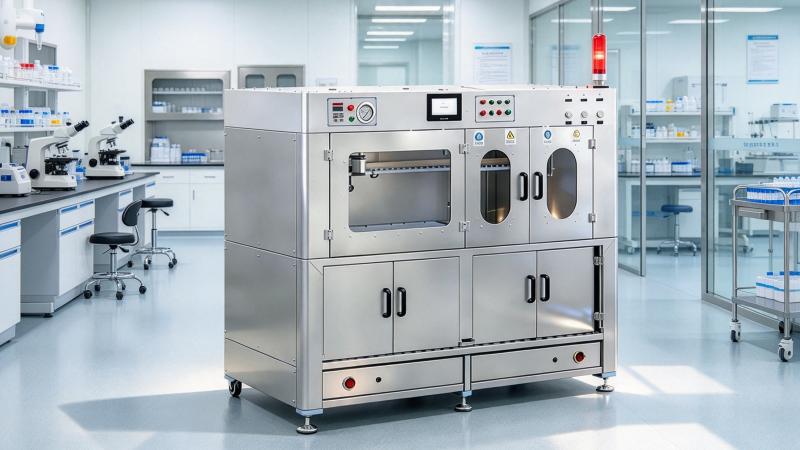
For companies developing or optimizing paclitaxel-coated balloons, Cheersonic can discuss ultrasonic spray coating equipment solutions and sample coating trials.
Customers are encouraged to provide:
- Balloon dimensions and materials.
- Paclitaxel-based coating formulation information.
- Solvent and excipient composition.
- Target drug loading.
- Existing coating method.
- Current coating challenges.
- Critical quality attributes to be evaluated.
- R&D or prototype production sample requirements.
Trials using representative balloon samples and coating formulations can help assess ultrasonic spray coating compatibility.
Learn more about Cheersonic coating equipment solutions:
https://cheersonic-liquid.com/en/ultrasonic-coating-equipment-solutions/
Conclusion
An Ultrasonic Drug Eluting Balloon Coating Machine can be used to investigate controlled deposition of paclitaxel-based drug coatings onto balloon catheter surfaces.
For drug-coated balloon development, optimization should not focus only on coating uniformity.
Drug loading, coating morphology, delivery stability, particle shedding, and drug transfer must also be considered.
Ultrasonic spray coating equipment provides an adjustable precision deposition platform, while final coating quality and device performance require comprehensive material, process, and functional testing.
For customers in the R&D and process optimization stages, small-batch sample trials are recommended to establish a suitable process window before progressing to prototype production and further product development.
