A Precision Coating Solution for Fuel Cell and Water Electrolysis Electrode Fabrication
Automated Ultrasonic Spray Coating Equipment for Membrane Electrode Assemblies: A Precision Coating Solution for Fuel Cell and Water Electrolysis Electrode Fabrication
Product Overview
Automated ultrasonic spray coating equipment for membrane electrode assemblies (MEAs) is designed for research, process development, and manufacturing in fuel cells, hydrogen production by water electrolysis, and related electrochemical devices. It can be used to deposit catalyst inks and functional coatings onto proton exchange membranes (PEMs), anion exchange membranes (AEMs), and other functional substrates.
The equipment integrates ultrasonic atomization, precision motion control, automated workpiece positioning, and optional substrate holding modules. Using predefined spray paths and process parameters, the system coats designated areas along programmed trajectories. An automatic flipping station can also be configured to support sequential or separate coating operations on both sides of the substrate.
For research teams developing membrane electrode assemblies, catalyst layers, or functional thin films, this solution helps transform manual operations into an automated process that can be documented, reproduced, and systematically optimized.
Core Functions and Technical Features
1. Ultrasonic Atomization for Precision Deposition of Functional Coatings
The ultrasonic nozzle uses high-frequency vibration to generate fine droplets, which the spraying system then delivers to the target area. For compatible catalyst inks and functional coating liquids, process development can focus on parameters such as liquid flow rate, atomization conditions, nozzle height, spray speed, and spacing between spray passes.
Compared with certain spraying methods that rely on high-pressure gas for direct atomization, ultrasonic spray coating can provide relatively gentle, adjustable droplet delivery conditions, helping reduce unnecessary splashing and overspray. Actual coating quality still depends on the ink formulation, substrate condition, nozzle configuration, and process parameters.
2. Automated Multi-Axis Motion Control for Improved Spray Repeatability
The equipment can incorporate a programmable multi-axis motion platform, with spray paths planned according to sample dimensions and the target coating area. Users can define the coating area, scanning path, nozzle height, and number of passes for different samples, then save validated process programs.
By reducing variations in speed, distance, and angle associated with handheld spraying, automated motion control helps improve process consistency across samples and supports subsequent parameter comparisons and experimental data traceability.
3. Automatic Flipping Station for Double-Sided Coating
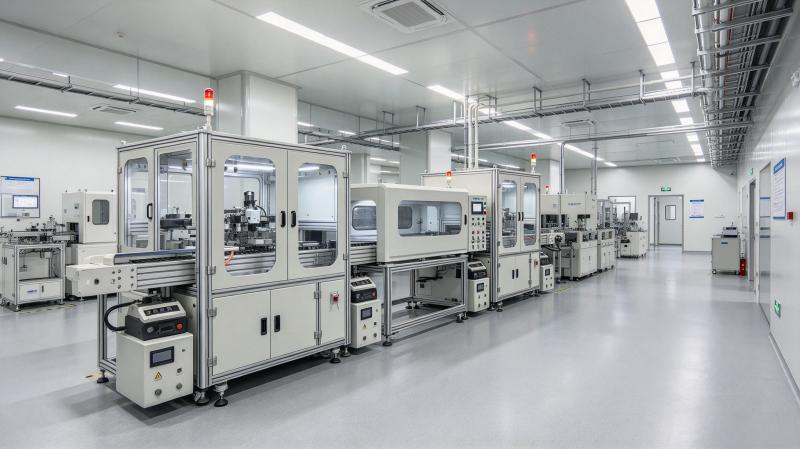
For applications requiring catalyst layers or functional films on both sides of a substrate, an automatic flipping mechanism can be configured according to sample dimensions, positioning requirements, and process cycle time.
Automatic flipping helps reduce manual handling and repositioning, lowering the risk of misalignment caused by repeated fixturing. For exchange membranes that deform easily, appropriate support, vacuum holding, and release methods must also be developed to prevent stretching, localized indentations, or edge damage during flipping.
4. Optional Vacuum and Heating Platforms for Flexible Substrate Control
For thin exchange membranes or flexible substrates, a vacuum hold-down platform, heated stage, or combined vacuum heating platform can be evaluated and configured according to process requirements.
Vacuum holding helps keep the substrate in contact with the support surface, reducing localized warping and movement during spraying. Temperature control can be used to investigate solvent evaporation, coating drying, and the effects of temperature during deposition.
Vacuum holding and heating are not suitable for every membrane material. For PEMs and AEMs that undergo dimensional changes upon contact with water, alcohols, or other solvents, membrane swelling behavior, allowable temperature, vacuum conditions, and dimensional recovery after vacuum release should be validated before platform parameters are established.
5. Process Program Management for Research and Pilot-Scale Development
Depending on the configuration, the equipment can provide programmable management of spray paths, operating sequences, and associated parameters. This supports formulation screening, catalyst layer fabrication, process repeatability studies, and pilot-scale process development.
For projects comparing different catalyst loadings, coating thicknesses, or processing conditions on opposite sides of a substrate, programmable control helps establish clear experimental records and reduce the influence of manual operations on results.
Typical Applications
- Catalyst layer fabrication for proton exchange membrane fuel cells (PEMFCs)
- Functional coating of electrochemical devices incorporating anion exchange membranes
- Development of membrane electrode assemblies and electrode components for hydrogen production by water electrolysis
- Deposition of catalyst inks, conductive materials, and functional polymer layers
- Single- or double-sided coating of flexible membranes and thin-film substrates
- Laboratory process development and pilot-scale validation
Suitability for each application should be evaluated based on ink viscosity, solids content, particle dispersion, solvent system, substrate dimensions, and target loading.
Configuration Options to Discuss Based on Project Requirements
The equipment configuration can be planned around the following modules:
- Ultrasonic spray coating unit and compatible liquid delivery system
- Programmable multi-axis motion platform
- Automatic flipping and workpiece positioning mechanisms
- Vacuum hold-down, heating, or combined vacuum heating platform
- Spray enclosure, exhaust ventilation, and solvent safety provisions
- Substrate fixtures for different sample dimensions
- Process program storage, operation control, and data recording
From Sample Validation to Automated Process Development
For membrane electrode assembly fabrication, equipment selection should consider more than the degree of automation. Catalyst layer uniformity, catalyst loading, membrane deformation, solvent evaporation, and electrochemical performance should all be evaluated together.
Before finalizing the equipment configuration, small-scale trials using the customer’s actual PEM or AEM materials and catalyst inks are recommended. Comparing coating quality under different substrate holding methods, spray paths, and drying conditions can help establish a reproducible process window.
If your research group or development team is working on membrane electrode assembly processes for fuel cells, hydrogen production by water electrolysis, or other electrochemical applications, automated spray coating and substrate holding solutions can be discussed based on your sample dimensions, ink system, and target coating requirements.
Email: market2@cheersonic.com
