
Precision Sidewall Coating of Inorganic Thin Substrates
Process Application of Ultrasonic Spraying Systems for Precision Sidewall Coating of Inorganic Thin Substrates
In the fields of microelectronics, semiconductor, and functional material manufacturing, uniformly coating the sidewalls of small inorganic solid substrates is a common yet highly challenging process requirement. Taking a silicon-wafer-like inorganic substrate (measuring 8 mm wide, 12 mm long, and 2 mm high) as an example, the four sidewalls present narrow surface areas and sharp edges; traditional air-pressure spraying or dip-coating processes often struggle to achieve precise coating thickness without edge overflow. Ultrasonic spraying technology, with its capability for micron-level droplet control and low-flow-rate stability, has emerged as the preferred solution for such precision sidewall coating applications.
The core principle of an ultrasonic spraying system involves using a transducer to convert high-frequency electrical energy into mechanical vibration. This vibrational energy is transmitted to the liquid film at the nozzle tip, causing it to break up into uniform, micron-sized droplets at the resonant frequency. Unlike traditional two-fluid atomization, ultrasonic atomization does not rely on compressed air; it offers a narrower droplet size distribution and a lower, more stable spray rate. This enables precise material deposition on extremely small areas, making it particularly suitable for producing ultra-thin coatings in the 2- to 10-micron range.
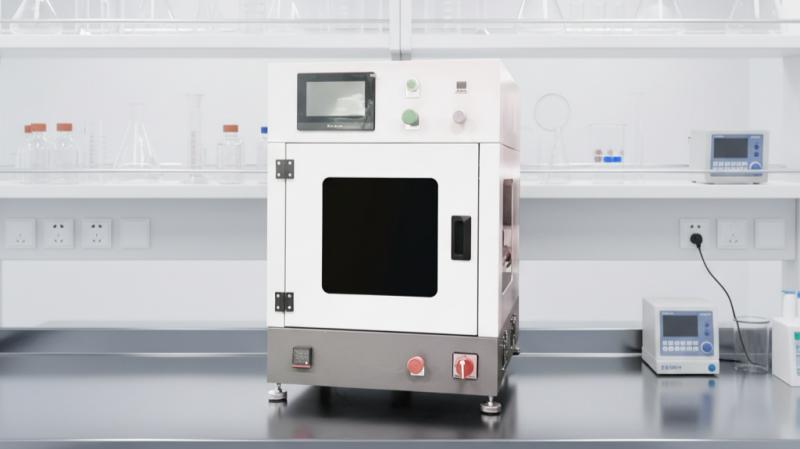
The two spraying solutions involved in this application exhibit significantly different viscosity characteristics. The first solution has a viscosity of 12.2 cP (medium-to-high viscosity); during ultrasonic atomization, it requires higher vibration amplitude or a lower feed rate to ensure continuous atomization and droplet uniformity. The second solution has a viscosity of 6–8 cP and flows more easily, making atomization relatively straightforward; however, the spray volume must be carefully controlled to prevent sagging or running on the vertical sidewalls. Both solutions cure within approximately six seconds of application. While this rapid curing helps maintain coating morphology and reduces leveling time, it also imposes stricter requirements on spray path planning and cycle time control: the complete deposition of a single coating layer must be finished before curing begins; otherwise, poor interlayer adhesion or surface defects are likely to occur. Regarding target thickness, the 2-micron and 10-micron specifications serve distinct functional requirements. The 2-micron ultra-thin coating is typically used for insulation passivation, interface modification, or as a sacrificial layer, demanding exceptional thickness uniformity and density; conversely, the 10-micron coating is primarily applied for protection, electrical conduction, or functional composite layers, allowing for slightly looser tolerances while still requiring complete sidewall coverage. Ultrasonic spraying systems can precisely control the deposition amount per unit area—and thus consistently achieve both target thicknesses—by adjusting parameters such as feed rate, the relative movement speed between the nozzle and the workpiece, scan spacing, and the number of coating passes.
Coating the four sidewalls presents specific challenges regarding fixture design and motion control. Given the workpiece height of only 2 mm, the four sidewalls are narrow vertical surfaces; the process requires positioning the nozzle parallel to the sidewall or at a specific tilt angle, while utilizing a multi-axis coordinated motion platform to rotate or translate the workpiece sequentially, ensuring uniform spray coverage on every sidewall. Furthermore, the nozzle-to-workpiece distance must be precisely calibrated: excessive distance leads to premature solvent evaporation and powder deposition during droplet flight, whereas insufficient distance risks coating unevenness caused by airflow turbulence. Leveraging the 6-second curing window, a process sequence of “spray one sidewall—brief pause for curing—rotate to next sidewall” effectively prevents coating interference and edge accumulation between adjacent sidewalls.
In summary, ultrasonic spraying offers unique process advantages for coating the four sidewalls of silicon-like inorganic thin substrates. By optimizing atomization parameters for solutions with viscosities of 12.2 cP and 6–8 cP, and synchronizing motion sequences with the 6-second rapid curing cycle, the system consistently produces uniform sidewall coatings at both the 2-micron and 10-micron target thicknesses. This process solution holds significant potential for widespread application in fields such as semiconductor packaging, MEMS devices, and functional ceramic thin films.
About Cheersonic
Cheersonic is the leading developer and manufacturer of ultrasonic coating systems for applying precise, thin film coatings to protect, strengthen or smooth surfaces on parts and components for the microelectronics/electronics, alternative energy, medical and industrial markets, including specialized glass applications in construction and automotive.
Our coating solutions are environmentally-friendly, efficient and highly reliable, and enable dramatic reductions in overspray, savings in raw material, water and energy usage and provide improved process repeatability, transfer efficiency, high uniformity and reduced emissions.
If you have any technical questions, customization demands, or procurement inquiries about ultrasonic atomization nozzles, feel free to contact our professional sales and technical team for detailed parameters, customized solutions, and industry application support.
Email: market2@cheersonic.com
